PVC Geomembrane
Plasticised PVC Waterproofing Membrane
The crystalline structure of HDPE gives it strength but limits its flexibility; the amorphous structure of PVC does exactly the opposite — it conforms readily to complex geometries such as corners, pipe penetrations and irregular concrete surfaces. PVC geomembrane, in thicknesses from 0.80 mm to 3.50 mm and in plain, signal-layer, UV-stabilised, T-GRIP or felt-laminated options, is used with confidence in every application where concrete must be protected.
- Category
- Lining & Sealing
- Product Group
- Plasticised PVC Waterproofing Membrane
- Product Code
- PVC-DUZ / -SIGNAL / -UV / -TGRIP / -KECE
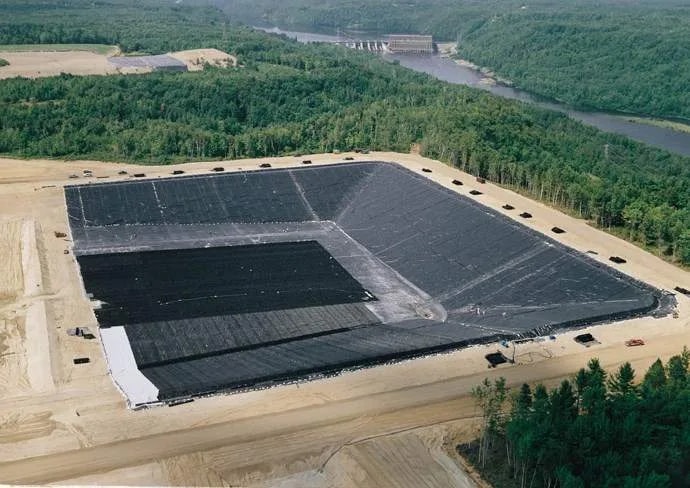
In Bulletin 135 of the International Commission on Large Dams (ICOLD), PVC-P geomembrane was the primary sealing material in 76% of the 176 membrane-faced rockfill dams examined — a concrete reference showing that PVC's place in water structures is no accident. PVC geomembrane carries the same material family (plasticised PVC) across a wide range of applications, from dams and ponds to tunnel waterproofing, from foundation tanking to green roofs.
What is a PVC Geomembrane?
PVC geomembrane is produced by blending PVC resin with plasticisers, stabilisers and UV additives and forming it by calendering. Unlike the crystalline molecular structure of HDPE, PVC has an amorphous structure; this gives the material a far higher elongation capacity and flexibility even at low temperatures — which is why it is easier to install than HDPE on structures with complex geometry (tunnels, bridges, foundations).
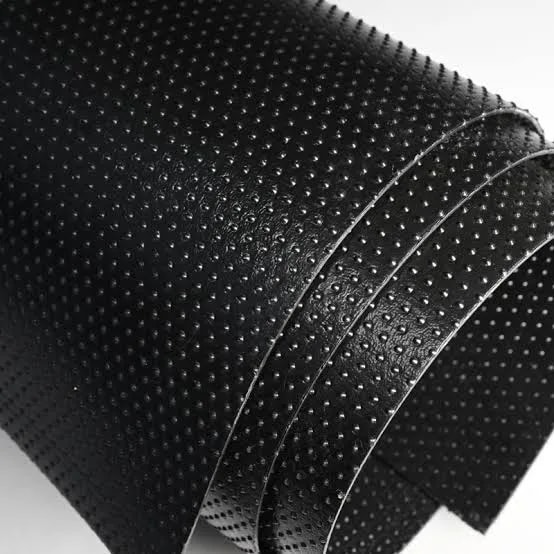
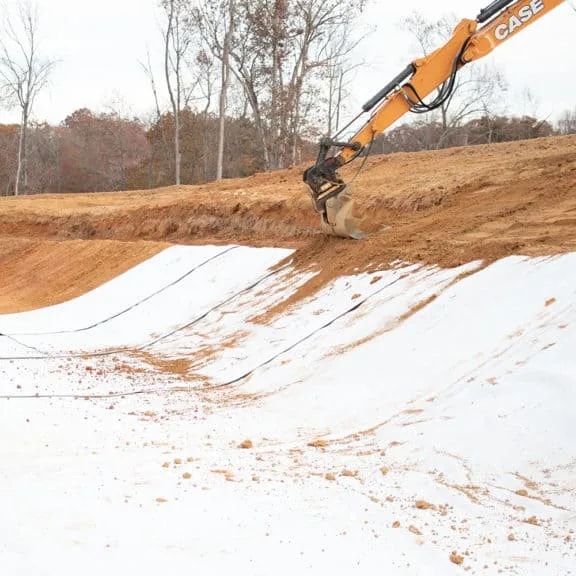
The product is manufactured in five different types: - **Plain:** The standard, unmodified base membrane. - **Signal layer:** A thin layer of a contrasting colour runs through the membrane section; if the membrane is damaged during site installation or subsequent works, this layer becomes visible and gives early warning. - **UV-stabilised:** Contains additional UV stabiliser for exposed (uncovered) applications; preferred on roofs, terraces and open pools. - **T-GRIP:** Produced with a textured/gripping surface, designed to form a mechanical bond with fresh concrete or a screed poured over it. - **Felt-laminated:** A non-woven felt is laminated to one or both faces; this provides additional impact/puncture protection and improves adhesion performance on surfaces in contact with concrete.
**One must be clear about chemical resistance:** PVC performs well against the acids, bases and alcohols found in groundwater. However, in environments containing ketones, esters or aromatic hydrocarbons, plasticiser loss can accelerate; on projects with such aggressive chemical exposure (certain oil/refinery applications, for instance) chemical compatibility must be verified before use. This is in fact what governs the long-term performance of PVC geomembranes: the material's principal degradation mechanism is not oxidation, as it is in HDPE, but the plasticiser separating from the material surface and being lost over time. For this reason the PVC Geomembrane Institute's PGI-1104 specification requires an average plasticiser molecular weight of at least 400, in order to ensure long-term plasticiser retention.
Why this material?
Easy installation on complex geometry
Thanks to its amorphous structure, it is installed on corners, pipe penetrations and irregular surfaces with less cutting and welding labour than HDPE.
Direct compatibility with concrete
The T-GRIP and felt-laminated types form a mechanical bond with fresh concrete and can reduce the need for a separate protection concrete in foundation tanking and tunnel/bridge structures.
Early damage detection (signal-layer type)
A puncture caused on site, or damage caused by subsequent construction activity, can be detected visually thanks to the signal layer; this allows repair before the membrane is covered.
Inherent fire resistance
The chlorine content of PVC causes the material to self-extinguish once the source of flame is removed; this is why PVC-based roofing membranes pass Class A/B fire classification tests in many countries — HDPE/PE-based materials do not have this property.
Where does it work on site?
Water Structures (Dams, Ponds, Reservoirs, Irrigation Canals, Pools, Harbour Works)
The prevalence of PVC-P geomembranes in dam and reservoir applications is supported by many years of field performance data. The signal-layer type is preferred particularly on large-area dam and pond projects, for the early detection of site-induced damage. In pool applications (swimming, ornamental, settlement, aeration) the UV-stabilised type should be chosen for the edge zones that do not remain below the water line.
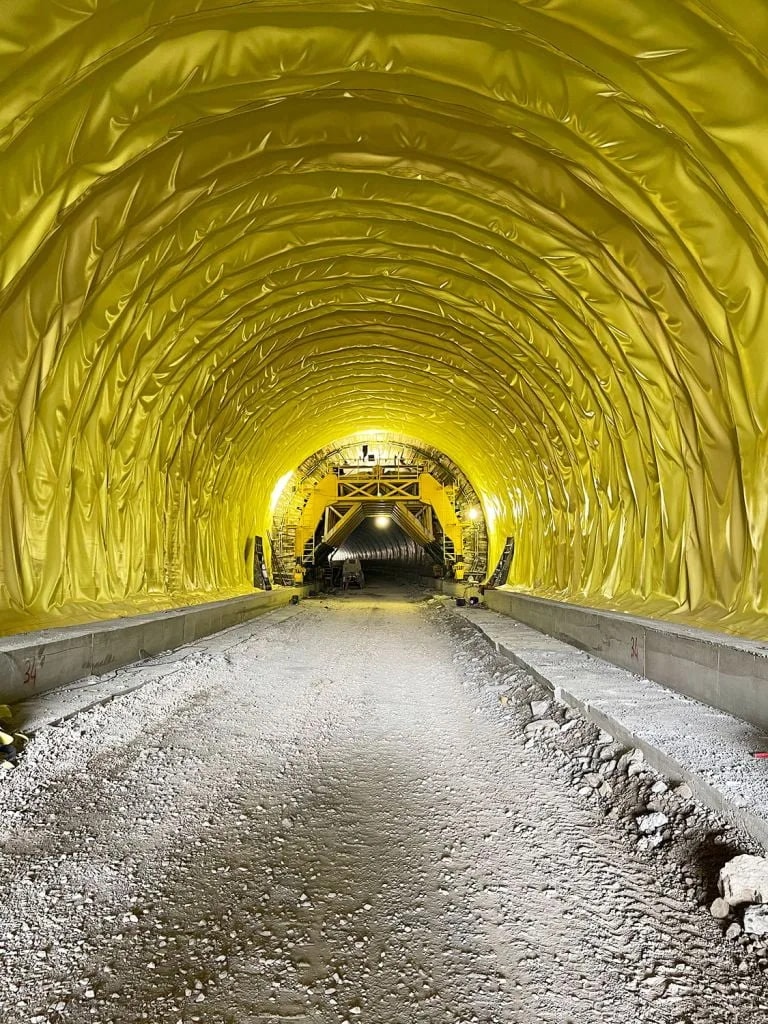
Underground and Concrete Structures (Tunnels, Bridges/Viaducts, Foundation Tanking, Underground Car Parks)
In these structures the membrane is generally in direct contact with concrete or screed; the T-GRIP or felt-laminated type forms a mechanical bond and reduces the risk of separation at the membrane–structure interface. In tunnel and bridge applications the signal-layer type is widely preferred, in order to detect punctures caused by reinforcement or formwork elements during construction before the membrane is covered.
Industry and Mining (Industrial Waste Storage, Treatment Plants, Oil and Mine Sites)
On these sites the chemical content must be assessed project by project. PVC is a suitable choice for aqueous waste, most industrial treatment processes and mine drainage water; however, where there is a risk of direct and prolonged contact with fluids high in solvent, oil or aromatic hydrocarbon content, chemical compatibility testing (EN 1847 / ASTM D5747, D5496, D5322) is recommended before use.
Roofs and Terraces (Timber, Steel, Green Roofs, Trafficked/Non-trafficked Terraces)
In these exposed applications the UV-stabilised type is mandatory. On green roofs the continuous, seamlessly welded structure of the membrane forms a physical barrier against plant roots. On trafficked terraces the felt-laminated type provides an additional protective layer against the pedestrian traffic and paving material above.
Measured values.
The values below are typical/minimum limits. A lot-specific certified test report should be requested before ordering.
| Property | Test Standard | Value |
|---|---|---|
| Thickness | ASTM D5199 | 0,80 – 3,50 mm |
| Roll width | — | Max 2,40 m |
| Roll length | — | Max 60 m (on request) |
| Production capacity | — | 1,000 kg/h |
| Tensile properties | ASTM D882 / PGI-1104 | Increases with thickness — e.g. ≥ 12.8 kN/m at 1.00 mm |
| Elongation at break | ASTM D882 / PGI-1104 | ≥ 360 – 430% (by thickness) |
| Plasticiser molecular weight | PGI-1104 | ≥ 400 |
| Chemical resistance | EN 1847 / ASTM D5747, D5496, D5322 | Project-specific |
| Microbiological resistance | ASTM G160 / G21 | Change after soil burial: strength ≤ 5%, elongation ≤ 20% |
| Type | Function |
|---|---|
| Plain | Standard base membrane |
| Signal Layer | Coloured ply in the cross-section; visual early warning in case of damage |
| UV-Stabilised | Additional UV stabiliser for exposed applications |
| T-GRIP | Textured/anchor-stud surface for mechanical bond with fresh concrete/screed |
| Felt-Laminated | Single/double-sided felt; added protection and bonding performance with concrete |
In brief
- A wide thickness range from 0.80 to 3.50 mm, with roll widths up to 2.40 m
- Five distinct types: plain, signal-layer, UV-stabilised, T-GRIP and felt-laminated
- Markedly higher elongation and low-temperature flexibility than HDPE, thanks to its amorphous structure
- Plasticiser molecular weight verifiable to PGI-1104 (long-term retention)
- Inherent fire resistance from its chlorine content (Class A/B roof tests)
- A quality test report for every product, issued by an independent laboratory and by our own
Test standards
- ASTM D7176
- Specification for Non-Reinforced PVC Geomembranes
- ASTM D5199
- Thickness
- ASTM D882
- Tensile Properties of Thin Plastic Sheeting
- PGI-1104
- PVC Geomembrane Institute Plasticiser Molecular Weight Requirement
- EN 14575
- Oxidation Resistance
- EN 14415
- Water Absorption / Immersion Resistance
- EN 1847
- Together with ASTM D5747, D5496, D5322 — Chemical Resistance
- ASTM G160 / G21
- Microbiological Resistance
- EN 13361
- Geosynthetic Barriers in Dam and Reservoir Construction
Rolls should be wrapped in stretch film and stored in an enclosed, dry area. The non-UV-stabilised (plain) type must be protected from sunlight during prolonged outdoor storage.
- The principal degradation mechanism of PVC-P geomembranes is plasticiser loss; the OIT test used for HDPE does not apply here. Plasticiser molecular weight (PGI-1104) and ageing test results (EN 14575/14415) should be taken as reference.
- Prior to prolonged direct contact with liquids containing ketones, esters or aromatic hydrocarbons, chemical compatibility testing (EN 1847 / ASTM D5747, D5496, D5322) is recommended.
- The full technical definition and surface geometry of the T-GRIP type should be confirmed with the manufacturer's technical documentation.
- For every product, quality test reports issued both independently and by our own laboratory are available on request.
“For every product, quality test reports issued independently and by our own laboratory are available on request.”
A choice grounded in data.
The performance of a PVC geomembrane rests on a different question from that of HDPE: “how long does the plasticiser stay inside the material?” The ≥400 molecular weight that PGI-1104 requires is the laboratory-verifiable answer to that question. When selecting a PVC product, the long-term retention data of the plasticiser system used should be interrogated just as closely as thickness or colour.
Frequently asked
Should I choose PVC or HDPE geomembrane?
On structures with complex geometry (tunnels, bridges, foundations, pipe penetrations), the high flexibility of PVC is an advantage. On large flat-surfaced sites with direct aggressive chemical exposure (certain landfill and oil applications), the broader chemical resistance range of HDPE may be safer. The choice should be made according to the geometry of the project and the chemical content of the water or liquid.
What actually determines the service life of a PVC geomembrane?
Not oxidation, but plasticiser loss. Over time the plasticiser can separate from the material surface and evaporate; this causes the membrane to harden and eventually become brittle. The use of a high-molecular-weight plasticiser (the PGI-1104 requirement of ≥400) slows this process.
What is the signal-layer type for?
The thin, contrasting-coloured layer within the membrane section becomes visible in the event of a site-induced puncture. It is a quality-control tool that allows damage to be found and repaired before the membrane is covered (before concrete pouring or backfilling).
What is the difference between the T-GRIP type and the plain type?
T-GRIP has a textured/gripping surface designed to form a mechanical bond with fresh concrete or screed. This creates an interlock between the membrane and the concrete poured over it that blocks water movement; it is preferred in applications in direct contact with concrete, such as foundation tanking.
Which chemicals should a PVC geomembrane not contact?
Liquids containing ketones, esters and aromatic hydrocarbons can accelerate plasticiser loss. On projects with such chemical content, compatibility testing under EN 1847 or ASTM D5747/D5496/D5322 is recommended before use.
Why is PVC geomembrane preferred on green roofs?
Its continuous, seamlessly welded structure forms a physical barrier against plant roots, and the UV-stabilised type provides long-term durability at exposed edges and details. In addition, the inherent fire resistance arising from PVC's chlorine content is an advantage in roof fire-safety specifications.
The geometry of your project, its contact with concrete and its chemical exposure conditions determine the right PVC type (plain / signal-layer / UV-stabilised / T-GRIP / felt-laminated) and thickness. Request a project-specific quote and an independent laboratory test report from our technical team.