Pipeline Rock Shield
HDPE Pipeline Protection Wrap (Rock Shield)
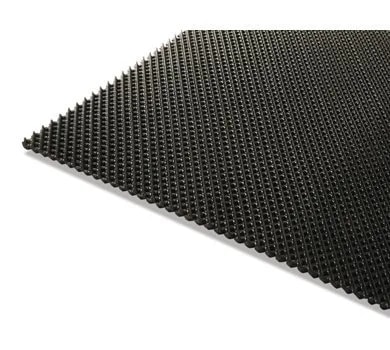
A pipeline's coating is sound when it is lowered into the trench — the trouble begins during backfill. Stones, debris and rock fragments in the fill can create small defects in the coating (discontinuities known as “holidays”), and those points become where corrosion starts years later. A rock shield meets and spreads those impacts with the three-dimensional HDPE mesh wrapped around the pipe — before they reach the coating.
- Category
- Protection
- Product Group
- HDPE Pipeline Protection Wrap (Rock Shield)
- Product Code
- RS (Ham Çekirdek) / RS-L (Laminasyonlu)
The rock shield derives from the same basic production logic as our geonet products: the three-dimensional mesh structure of HDPE. The difference lies in its function — where a geonet carries water in-plane, a rock shield absorbs and distributes impact energy to protect the coating. That structure is deliberately left open, because for the cathodic protection system used on steel pipelines to work, the pipe's contact with the surrounding soil must not be broken. A solid, closed sheet would defeat that protection, whereas the mesh structure of a rock shield lets water and electric current pass freely.
What is a Pipeline Rock Shield?
Geoals produces the rock shield in two structures: **raw core** (unlaminated, pure HDPE mesh) or **single-/double-sided laminated** (with a permeable geotextile heat-laminated to one or both faces of the mesh). The laminated type provides additional cushioning and reduces the penetration of fine fill material into the mesh.
The open structure of the design is not incidental: the cathodic protection system widely used on steel pipelines relies on electrical continuity with the electrolyte (soil/moisture) around the pipe. Wrapping the pipe in a fully closed, impermeable material breaks that continuity and disables the protection system. The mesh structure of a rock shield absorbs impact energy without breaking that electrical continuity — this is the technical reason the product can carry both its “protection” and its “cathodic compatibility” functions at once.
In the industry the performance of such products is measured by ASTM G14 (drop-weight impact resistance test); the widely accepted minimum impact resistance threshold is 120 in-lb. The product is designed for backfill conditions containing rock fragments of roughly 50 mm (2 inches) in diameter and below; backfills containing larger rock may require additional measures (selected fill material, extra cushioning).
Why this material?
It preserves coating integrity and lowers corrosion risk
Coating damage caused during backfill (“holidays”) is where corrosion begins over a pipeline's service life. Mechanical protection is the cheapest and earliest stage at which that risk can be prevented.
It does not block cathodic protection
The open mesh structure preserves the electrical continuity of the cathodic protection system used as a corrosion measure on steel pipes; this is a significant advantage over solid protection materials.
Fast, simple installation
It is wrapped around the pipe from a roll and fixed with non-metallic tape or clamps; it requires no special equipment or specialist labour.
A flexible structure, workable even at low temperatures
The material is flexible enough to accommodate pipe movement (thermal expansion, ground settlement) and does not become brittle in cold weather.
Where does it work on site?
Oil and Gas Transmission Pipelines
On these lines the coating is typically fusion-bonded epoxy (FBE) or a similar external coating, and coating integrity is a critical parameter for pipeline safety. The rock shield protects the coating during backfill without impeding the function of the cathodic protection system — which is used almost universally on these lines.
Water Mains and Water Conveyance Lines
On potable water or wastewater conveyance lines the pipe material may be steel or polymer (PE, PVC). On steel pipes, coating protection and cathodic compatibility apply in the same way; on polymer pipes the shield functions primarily as a physical protection layer against the risk of scoring and puncture.
Measured values.
The values below are typical/minimum limits. A lot-specific certified test report should be requested before ordering.
| Property | Test Standard | Typical Value |
|---|---|---|
| Raw material | — | HDPE |
| Structure | — | Three-dimensional open/voided mesh |
| Thickness | — | ~11 mm and above |
| Impact resistance | ASTM G14 | ≥ 120 in-lb |
| Compatible backfill stone size | — | ~50 mm (2 in) diameter and below |
| Lamination | — | None / single-sided / double-sided permeable geotextile |
| Cathodic protection compatibility | — | Yes (open mesh structure) |
Values are industry reference ranges; definitive impact resistance and thickness data are documented in the product-series-specific test report.
| Step | Description |
|---|---|
| Wrapping direction | Longitudinal, circumferential (ring) or spiral wrapping |
| Overlap position | Pipe invert (6 o'clock position), where the load is greatest |
| Overlap amount | ~10 – 15 cm (4 – 6 in) |
| Fastening | Non-metallic tape, clamp or tie |
| Backfilling | First layer placed by hand or with care, without dumping material directly onto the pipe |
| Parameter | Value |
|---|---|
| Roll width | ~1.2 – 1.8 m (varies with type) |
| Roll length | ~30 m (varies with type) |
| Colour | Black / yellow (for visibility) |
In brief
- Available as a raw core or with single-/double-sided geotextile lamination
- Impact resistance tested to ASTM G14
- Full compatibility with cathodic protection systems, thanks to the open mesh structure
- Suitable for backfill conditions containing stone/debris up to roughly 50 mm in diameter
- Fast site installation with non-metallic fixings
- A structure that retains its flexibility even at low temperatures
Test standards
- ASTM G14
- Impact Resistance Test for Pipeline Coatings (Falling Weight Method)
- ASTM G13
- (Related/alternative) Limestone Drop Impact Test
Rolls should be stored wrapped in stretch film, in an enclosed area away from direct sunlight.
- The product is designed for backfill conditions containing stones up to approximately 50 mm in diameter; on sites with larger rock fragments, select backfill material or additional cushioning is recommended.
- On steel pipelines with cathodic protection, ensure that the open mesh structure preserves electrical continuity; fully closed/impermeable alternative products may impede this function.
- The laminated type provides extra cushioning and protection against fines intrusion; the bare-core type is a more economical basic protection option.
- Definitive impact resistance and thickness data are documented in the product-series-specific MQC report.
“The first enemy of a pipe coating is the backfill — the rock shield protects your line from the very first bucket.”
A choice grounded in data.
The real test of a rock shield is passed not in a laboratory but during backfill — and that moment cannot be taken back. Damage to the coating remains a silent corrosion risk for the entire service life of the pipe. The impact resistance of our rock shield, documented to ASTM G14, and its cathodic protection compatibility reduce that risk at the moment of installation — at the stage from which there is no return.
Frequently asked
Why is a rock shield produced as a mesh rather than a solid material?
Because the cathodic protection system used on steel pipelines relies on electrical contact with the soil around the pipe. A solid, impermeable wrap gets in the way of that contact and disables the corrosion protection system. An open mesh structure provides impact protection while preserving that electrical continuity.
Against what size of rock does a rock shield protect?
The general reference is stone and debris up to roughly 50 mm (2 inches) in diameter. Backfills containing larger rock fragments may require complementary measures, such as the use of selected (screened) fill material or additional cushioning.
How is a rock shield installed?
The roll is wrapped so as to fully enclose the pipe; the overlap is generally made at the bottom of the pipe (the 6 o'clock position), where the weight bears most, and fixed with non-metallic tape or clamps. During backfill, material should not be dropped directly onto the pipe, and the first layer should be placed carefully.
What is the difference between the raw core and the laminated type?
The raw core is a pure HDPE mesh and provides the basic impact protection. The laminated type is produced by heat-bonding a permeable geotextile to one or both faces of the mesh; this provides additional cushioning and reduces the penetration of fine fill material into the mesh.
Can a rock shield also be used on polymer (PE/PVC) pipes?
Yes. Although cathodic protection is not a factor, on polymer pipes the shield functions as a physical protection layer against the risk of scoring and puncture from hard material in the backfill.
The coating type of your pipeline, the rock content of the backfill and the presence of a cathodic protection system determine the right rock shield type (raw core or laminated). Request a project-specific technical quote and an ASTM G14 test report from the Geoals technical team.