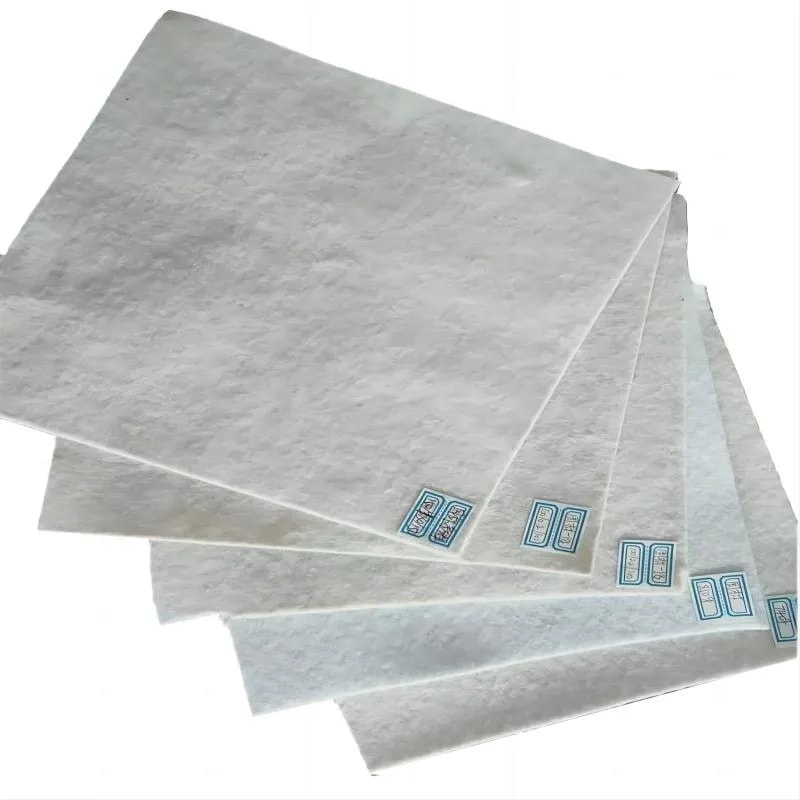
PET Geotextile
Polyester (PET) Non-Woven Geotextile
Compared with a PP geotextile of the same weight, PET (polyester) fibres generally offer higher tensile and puncture resistance, because their molecular structure is stiffer. But this advantage has a limit: polyester fibres undergo hydrolysis in alkaline environments above pH 10 and lose strength over time. PET geotextile is therefore recommended for the drainage, separation and filtration of waters that carry no chemical content, or that are neutral in pH.
- Category
- Separation & Filtration
- Product Group
- Polyester (PET) Non-Woven Geotextile
- Product Code
- GT-PET-NW
The first question to ask when selecting a geotextile should be: “what is in this water?” On a project working with chemically neutral water — fresh water, rainwater, irrigation water — PET geotextile offers higher strength and lower permanent deformation (creep) than PP at the same weight. But where there is a risk of direct contact with highly alkaline liquids such as leachate or mine drainage water, our PP geotextile line is the more suitable choice. This page explains the real technical advantage PET provides when used correctly — and its limits.
What is a PET Geotextile?
PET geotextile is a non-woven geocomposite produced by needle-punching continuous filament polyester (PET) fibres and, at certain weights, additionally calendering them. The specific gravity of PET is approximately 1.38 kg/dm³ (markedly denser than PP's ~0.91 kg/dm³); however, the stiffer molecular structure of PET fibres generally delivers higher tensile strength, lower elongation at break and lower long-term creep than PP at the same weight. This makes PET advantageous particularly in applications requiring dimensional stability under sustained load (repeated traffic loading in a road subgrade, for example).
But PET's chemical limit is clear: polyester fibres undergo alkaline hydrolysis once the pH exceeds 10, and this reduces the strength of the material over time. PET geotextile is therefore not recommended in environments such as leachate at solid/hazardous waste sites, direct prolonged contact with cement or concrete, or highly alkaline mine drainage water; on such projects our PP geotextile line should be preferred. Conversely, PET can be used with confidence in filtration, separation and drainage applications working with neutral-pH liquids such as fresh water, rainwater and irrigation water.
Why this material?
Higher strength at the same weight
The stiff molecular structure of PET fibres generally provides higher tensile and puncture resistance than a PP geotextile of the same weight; this makes it possible to select a lighter — and therefore more economical — product for the same performance.
Low creep, high dimensional stability
PET's low tendency to permanent deformation is an advantage in applications requiring long-term performance under repeated loading (traffic, fill settlement).
Reliable performance in clean-water filtration
In flood protection, irrigation and drainage projects working with neutral-pH water, PET's chemical limit never comes into play; in these applications its strength advantage is realised in full.
Knowing the limits prevents field failure
Knowing the pH 10 threshold makes it possible to determine in advance on which projects PP should be chosen instead of PET — which removes the risk of early degradation after installation.
Where does it work on site?
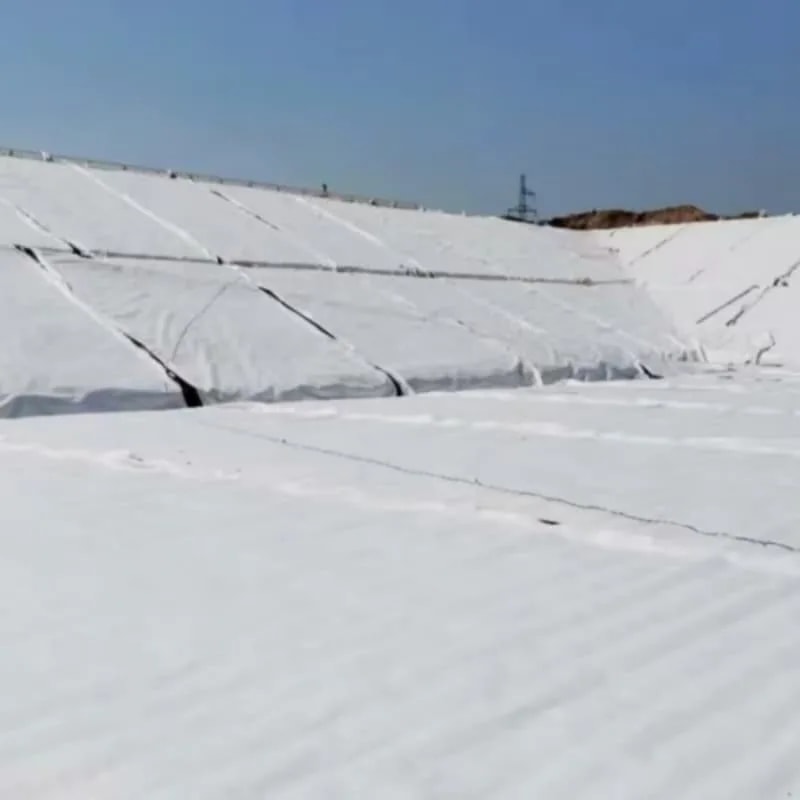
Irrigation Canals, Ponds, Pools and Channels
In these applications the water is generally chemically neutral; PET geotextile performs both soil separation and filtration with higher strength than PP at the same weight. The same filtration logic applies to fill soils beneath high-flow water in flood protection projects: the geotextile's AOS value must be selected according to the grain size distribution (D85) of the soil to be retained.
Solid, Medical and Hazardous Waste Sites
On these sites PET geotextile should be used not in the layers in direct contact with leachate, but in the clean surface-water drainage ditches around the facility and in rainwater diversion channels. In layers carrying a risk of high alkalinity, such as the leachate collection system, our PP geotextile line should be preferred.
Mine Sites
The pH of mine drainage water can vary greatly from site to site (from acid mine drainage to alkaline process waters). PET geotextile can be used safely in the site's clean surface-water diversion channels; in layers in direct contact with process water or heap leach solution, pH must be verified before use and PP preferred if necessary.
Oil Fields and Tank Farms
PET geotextile is suitable for clean rainwater drainage around tanks. In secondary containment layers carrying a risk of direct contact with a possible hydrocarbon leak, the PP line is recommended.
Tunnels and Foundation Structures
In drainage behind tunnels and in foundation drainage systems, groundwater is generally in the neutral pH range; in these applications PET's high puncture resistance provides additional protection against the sharp surface of the drainage gravel. If a chemical analysis of the groundwater in the project area is available, it should be confirmed that the pH remains below 10.
Roads and Railways
Long-term dimensional stability of the subgrade matters under repeated traffic loading; PET's low creep offers an advantage over PP in such repeated-load scenarios. The separation function prevents the granular fill from mixing with the natural soil and so allows a homogeneous subgrade to be formed.
Measured values.
The values below are typical/minimum limits. A lot-specific certified test report should be requested before ordering.
| Property | PET | PP |
|---|---|---|
| Specific gravity | ~1,38 kg/dm³ | ~0,91 kg/dm³ |
| Strength at equal weight | Higher | Reference |
| Elongation at break | Lower | Higher |
| Creep resistance | Higher | Medium |
| Chemical limit | Alkaline hydrolysis risk above pH 10 | Stable across a wide pH range |
| Property | Test Standard | Light | Medium | Heavy |
|---|---|---|---|---|
| Weight | ASTM D5261 / EN ISO 9864 | ~120 – 150 g/m² | ~200 – 300 g/m² | ~400 g/m²+ |
| Grab tensile strength | ASTM D4632 / EN ISO 10319 | ~10–30% higher than PP equivalent | ~10–30% higher than PP equivalent | ~10–30% higher than PP equivalent |
| Elongation at break | ASTM D4632 | %40 – 50 | %40 – 50 | %40 – 50 |
| CBR puncture (static) | ASTM D6241 / EN ISO 12236 | Higher than PP equivalent | Higher than PP equivalent | Higher than PP equivalent |
| Dynamic puncture | EN ISO 13433 | Varies with weight | Varies with weight | Varies with weight |
| AOS | ASTM D4751 / EN ISO 12956 | Selected by weight | Selected by weight | Selected by weight |
| Permittivity | ASTM D4491 | ~1,5 – 2,0 sn⁻¹ | ~1,0 – 1,4 sn⁻¹ | ~0,5 – 0,8 sn⁻¹ |
| UV resistance (500 h) | ASTM D4355 | ≥ %70 | ≥ %70 | ≥ %70 |
Definitive numerical values are documented in the product-series-specific MQC report; the table above shows industry reference ranges.
| Parameter | Value |
|---|---|
| Roll width | 2 – 6 m |
| Roll length | 50 – 150 m |
| Colour | White / Cream |
In brief
- A non-woven structure produced by needle-punching continuous filament PET fibres, calendered at certain weights
- Generally higher tensile and puncture resistance than PP at the same weight
- Dimensional stability under repeated loading, thanks to low creep
- Unrestricted compatibility with waters that stay below the pH 10 threshold
- Filtration designed to the soil's grain size distribution via AOS (ASTM D4751 / EN ISO 12956)
- Complementary product selection according to the project's water chemistry, alongside our PP geotextile line
Test standards
- ASTM D4632
- Grab Tensile Strength and Elongation
- ASTM D4533
- Trapezoidal Tear Strength
- ASTM D6241
- CBR (Static) Puncture Resistance
- ASTM D4833
- Index (Pin) Puncture Resistance
- ASTM D4751
- Apparent Opening Size (AOS)
- ASTM D4491
- Permittivity and Water Flow Rate
- ASTM D4355
- UV Resistance
- ASTM D5199
- Thickness
- ASTM D5261
- Mass per Unit Area
- EN ISO 10319
- Tensile Strength (MD/CMD)
- EN ISO 9864
- Mass per Unit Area
- EN ISO 9863-1
- Thickness
- EN ISO 12236
- Static Puncture (CBR) Test
- EN ISO 13433
- Dynamic Puncture (Cone Drop) Test
- EN ISO 12956
- Apparent Opening Size (Wet Sieving)
- AASHTO M288
- Geotextile Classification Specification (USA)
Rolls should be wrapped in stretch film and stored in an enclosed, dry area. After laying on site, they should be covered as soon as possible against UV and temperature exposure.
- PET geotextile is not recommended for prolonged direct contact with liquids exceeding pH 10 (certain leachates, alkaline process waters, fresh concrete); in such conditions the PP geotextile line should be preferred.
- In landfill, mining and oil-field applications, PET is recommended only for clean surface water/rainwater drainage; it must not be used in layers in direct contact with waste/process water.
- AOS selection should be matched to the particle-size distribution (sieve analysis, D85) of the soil to be protected.
- Values given by weight class are industry reference ranges; certified test results for our own product series are available on request.
“We state a product's limits clearly before the sale — PET's pH limit is part of that honesty.”
A choice grounded in data.
Using PET geotextile correctly begins with presenting an advantage together with its limit: PET is stronger at the same weight — but not in every water. This is why we offer the PET and PP lines together at Geoals — so that we can recommend the right product for your project's water chemistry, rather than trying to fit a single product to every situation.
Frequently asked
Should I choose PET or PP geotextile?
The choice depends on the chemical content of the water. If the water is neutral in pH (rainwater, irrigation water, clean groundwater), PET offers higher strength at the same weight. If the water is highly alkaline or chemically aggressive (leachate, certain mine drainage waters), PP should be preferred.
Why should PET geotextile not be used above pH 10?
Polyester fibres undergo a chemical degradation called hydrolysis in highly alkaline environments; over time this shortens the fibre chain and causes a loss of strength. The degradation is not instantaneous, but it has a cumulative effect under long-term exposure.
Can PET geotextile be in contact with concrete?
Short-term contact causes no problem, but prolonged direct contact with fresh concrete or cement paste is not recommended, because of the high alkalinity. In applications requiring continuous contact with concrete (foundation tanking, for example) bentonite-based products or PP geotextile are the more suitable choice.
How is the weight of a PET geotextile chosen?
Weight is determined by the function the geotextile is to perform: AOS and permittivity are the priority criteria for filtration, puncture resistance for protection, and tensile strength for separation. The soil's grain size distribution and the load coming onto it govern the selection of the right weight class.
How soon should PET geotextile be covered?
A geotextile left exposed loses strength over time through UV exposure and temperature; it should therefore be covered as soon as possible (within the period stated in the project specification, generally between a few days and a few weeks).
Can PET and PP geotextile be used on the same project at the same time?
Yes. Where different parts of the same project involve different water chemistry (PET in a landfill's clean surface-water channel, PP in its leachate collection layer, for instance), the two types can be used together, each in its correct function.
The chemical content of the water on your project determines whether you should choose PET or PP. Request a product recommendation matched to your water analysis data, together with a technical quote, from the Geoals technical team.