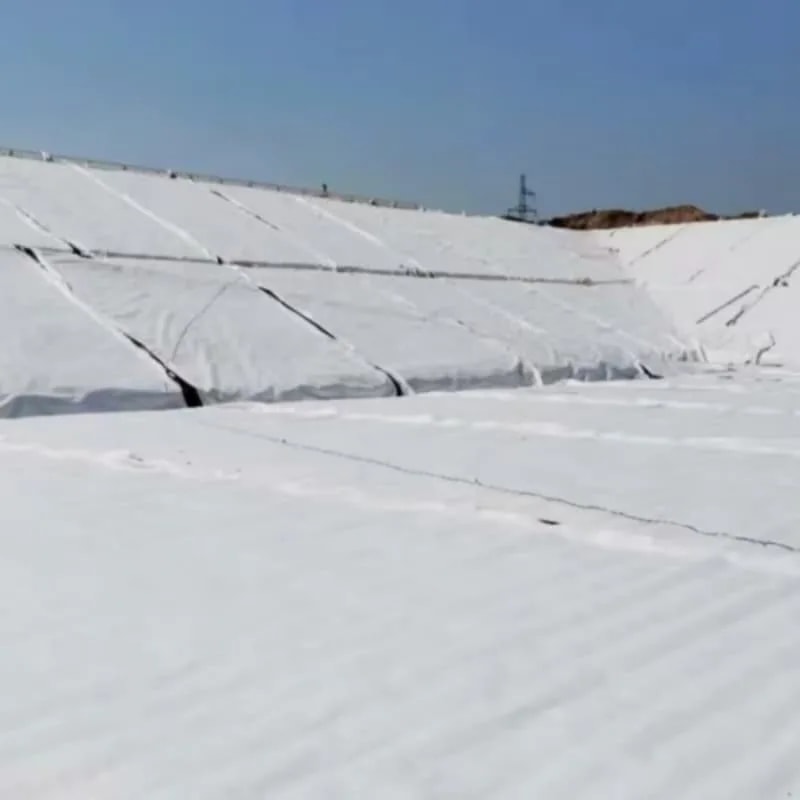
PP Geotextile
Polypropylene (PP) Geotextile — Woven / Non-Woven
A geotextile's job changes with the project: sometimes it is to stop two different soil layers from mixing, sometimes to pass water while retaining fine-grained soil, and sometimes to spread the load coming from above. PP geotextile is produced in two different structures according to which of these functions takes priority: woven for high tensile strength, non-woven for high permeability and protection.
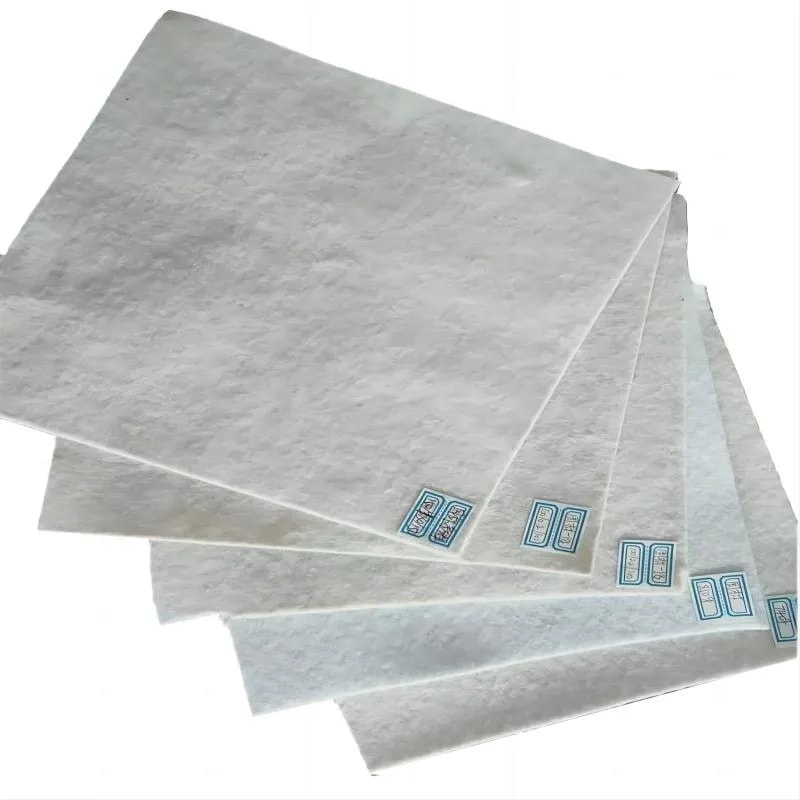
- Category
- Separation & Filtration
- Product Group
- Polypropylene (PP) Geotextile — Woven / Non-Woven
- Product Code
- GT-PP-WV (Dokuma) / GT-PP-NW (Dokusuz)
The most common mistake in selecting a geotextile is the assumption that thicker is better. Yet the property needed in a highway stabilisation is not the property needed in a geomembrane protection layer. PP geotextile, built on the natural chemical resistance of polypropylene, is produced on two separate lines — woven (high strength, low permeability) and non-woven (high permeability, high elongation); the right choice follows from whether the project's priority is separation, filtration, protection or reinforcement.
What is a PP Geotextile?
The **non-woven type** is produced by laying continuous filament or staple PP fibres at random and interlocking them mechanically by needle-punching. This production method gives an isotropic structure (similar behaviour in every direction) and high porosity; it is therefore preferred for filtration, drainage and protection functions.
The **woven type** is produced by weaving PP slit-film tapes or multifilament yarns. This structure raises tensile strength while keeping elongation low; it is therefore preferred for separation and soil reinforcement (stabilisation), particularly in road and railway subgrades.
The raw material in both types is polypropylene, and the reason for that choice is not incidental. PP is chemically stable across a wide pH range (in acidic and alkaline environments) and, notably at high alkalinity (in contact with concrete or lime-stabilised soil, for instance), does not carry the risk of alkaline hydrolysis that can be seen in polyester (PET) based geotextiles. This is the technical justification for preferring PP geotextile in chemically variable environments such as landfills and mine drainage water.
During production, parameters such as tensile strength, elongation at break, and static and dynamic puncture resistance are set according to the load and site conditions of the project. Static puncture resistance is tested to EN ISO 12236 (CBR test — the force of a 50 mm flat-ended plunger pushing through the geotextile), and dynamic puncture resistance separately to EN ISO 13433 (cone drop test — the diameter of the hole created by a 50 mm steel cone dropped from 0.5 m). Because these two tests simulate different damage scenarios (slow pressure and sudden impact), requesting both together reflects site installation risk more accurately.
Why this material?
The right function from the right type
The woven type, with high tensile strength and low elongation, is effective in soil reinforcement; the non-woven type, with high permeability, is effective in filtration and drainage. Choosing the wrong type means the function is not performed at all.
A chemically resistant raw material
The stable structure of PP across a wide pH range delivers long-term performance in aggressive environments such as landfill leachate, mine drainage water and hydrocarbon residues on oil sites.
Performance in proportion to site preparation
A geotextile can only perform its protection or separation function efficiently if the surface is cleaned and compacted before laying; the more careful the site preparation, the more predictable the geotextile's performance over its design life.
Testable, documentable performance
Tensile, tear, puncture (static/dynamic) and permeability values are tested separately to ASTM/EN standards; this provides a concrete reference in tender specification comparison.
Where does it work on site?
Oil Fields and Mine Sites
On these sites the non-woven type, laid beneath or above the geomembrane, acts as a protection layer preventing sharp aggregate or rock fragments from puncturing the membrane. Static and dynamic puncture resistance are decisive here; the sharper the drainage gravel, the heavier the non-woven grade that should be chosen. The chemical stability of PP against hydrocarbons and mine drainage water provides an additional assurance.
Solid, Medical and Hazardous Waste Sites
In the leachate collection system, the non-woven type performs both a filtration function (preventing fine particles from clogging the drainage pipes) and a protection function between the drainage gravel and the waste mass. In this application the apparent opening size (AOS, ASTM D4751 / EN ISO 12956) must be selected according to the grain size distribution of the soil to be retained — the wrong AOS leads either to clogging or to the escape of fine material.
Ponds, Pools, Irrigation Canals and Channels
Laid beneath a geomembrane, the non-woven type provides protection against sharp stones and root remnants in the ground; laid above the geomembrane, it prevents the stone or concrete lining placed over it from damaging the membrane. On the canal base it also performs a separation function between the natural soil and the drainage layer.
Foundation Structures
In foundation drainage systems (drainage behind diaphragm walls, base drainage), the non-woven type surrounds the drainage gravel and prevents fine soil particles from migrating into the drainage line; this keeps the drainage system functioning without clogging over time.
Roads and Railways
In road and railway subgrades built over soft or low-bearing-capacity soil, the woven type laid between the granular fill and the natural soil performs both a separation and a stabilisation (soil reinforcement) function. In this application classifications such as AASHTO M288 define minimum tensile and permeability values according to the fines content of the soil.
Landscaping Projects
Beneath footpaths and stone/gravel paving, the non-woven type performs soil separation and acts as a weed barrier; load-bearing criteria are secondary in this application, and light-to-medium grades are sufficient.
Measured values.
The values below are typical/minimum limits. A lot-specific certified test report should be requested before ordering.
| Property | Woven | Non-Woven |
|---|---|---|
| Primary function | Separation, stabilisation | Filtration, drainage, protection |
| Tensile strength | High | Medium |
| Elongation at break | ~%15 – 25 | ~%50+ |
| Permeability | Low | High |
| Property | Test Standard | Light | Medium | Heavy |
|---|---|---|---|---|
| Grab tensile strength | ASTM D4632 | ~400 N | ~900 N | ~1.700 N |
| Elongation at break | ASTM D4632 | %50 | %50 | %50 |
| Trapezoidal tear | ASTM D4533 | ~180 N | ~355 N | ~620 N |
| CBR puncture (static) | ASTM D6241 / EN ISO 12236 | ~1.100 N | ~2.200 N | ~4.560 N |
| Dynamic puncture (cone drop) | EN ISO 13433 | Varies with weight | Varies with weight | Varies with weight |
| AOS | ASTM D4751 / EN ISO 12956 | ~250 µm | ~180 µm | ~150 µm |
| Permittivity | ASTM D4491 | ~2,0 sn⁻¹ | ~1,4 sn⁻¹ | ~0,7 sn⁻¹ |
| UV resistance (500 h) | ASTM D4355 | %70 | %70 | %70 |
For the woven type, tensile values are additionally expressed by wide-width tensile testing (ASTM D4595 / EN ISO 10319); grab tensile (D4632) is considered more representative for non-woven types, wide-width tensile for woven/reinforcement products. Definitive values are stated in the MQC report for the ordered weight and type.
| Parameter | Woven | Non-Woven |
|---|---|---|
| Roll width | 2 – 5 m | 2 – 6 m |
| Roll length | 100 – 200 m | 50 – 150 m |
| Colour | Black / White | White / Grey |
In brief
- Two separate production lines — woven and non-woven — for selecting the right function per project
- The chemical stability of PP across a wide pH range, with superior resistance to alkaline hydrolysis compared with PET
- Static (EN ISO 12236 / ASTM D6241) and dynamic (EN ISO 13433) puncture resistance tested separately
- Filtration designed to the soil's grain size distribution via AOS (ASTM D4751 / EN ISO 12956)
- Tensile, tear and permittivity values scaled by grade class
- UV resistance tested (ASTM D4355), allowing project planning around exposure time
Test standards
- ASTM D4632
- Grab Tensile Strength and Elongation
- ASTM D4595
- Wide-Width Tensile Strength
- ASTM D4533
- Trapezoidal Tear Strength
- ASTM D6241
- CBR (Static) Puncture Resistance
- ASTM D4833
- Index (Pin) Puncture Resistance
- ASTM D4751
- Apparent Opening Size (AOS)
- ASTM D4491
- Permittivity and Water Flow Rate
- ASTM D4355
- UV Resistance (Xenon-Arc)
- ASTM D5199
- Thickness
- ASTM D5261
- Mass per Unit Area
- EN ISO 12236
- Static Puncture (CBR) Test
- EN ISO 13433
- Dynamic Puncture (Cone Drop) Test
- EN ISO 10319
- Wide-Width Tensile Strength
- EN 13249…13265
- Application-Based Characteristic Standards (roads, railways, drainage, erosion control, solid/liquid waste)
- AASHTO M288
- Geotextile Classification Specification (USA)
Rolls should be wrapped in stretch film and stored in an enclosed, dry area. During prolonged outdoor storage they must be protected from UV exposure with a cover.
- Values given by weight class are industry reference ranges; certified test results for our own product series are available on request.
- AOS selection should be matched to the particle-size distribution (sieve analysis) of the soil to be protected.
- Chemical compatibility should be verified before use in environments containing strong oxidising acids or chlorinated/aromatic hydrocarbons.
- In site installation, surface preparation and compaction are prerequisites for the geotextile to achieve its design performance.
“The right geotextile is selected by function, not by weight alone — work with our technical team for the type and class that fits your project.”
A choice grounded in data.
Selecting a PP geotextile correctly begins with accepting that there is no single “best” product: the choice between woven and non-woven depends on whether the project prioritises separation, filtration, protection or reinforcement. This is why two different lines are produced within Geoals — not so that one type can do every job, but so that every job is done with its right type.
Frequently asked
What is the difference between woven and non-woven geotextile, and which should I choose?
The woven type offers high tensile strength and low elongation; it is preferred in applications requiring soil reinforcement and separation, such as roads and railways. The non-woven type offers high permeability and elongation; it is preferred in filtration, drainage and geomembrane protection applications. The choice should follow the project's priority function.
What is the difference between static and dynamic puncture resistance?
Static puncture resistance (EN ISO 12236 / ASTM D6241) measures the resistance to a broad plunger pressed slowly into the geotextile and simulates a slow, sustained pressure (the weight of a rock fragment placed on it, for example). Dynamic puncture resistance (EN ISO 13433) simulates the sudden impact of a cone dropped from a set height. Because the two represent different damage scenarios, they are generally assessed together.
What is AOS (Apparent Opening Size) and why does it matter?
AOS is an indicator of the geotextile's pore size and must be matched to the grain size distribution of the soil to be retained in filtration applications. If the AOS is too large, fine soil particles pass through the geotextile (filtration fails); if it is too small, the geotextile clogs over time (permittivity falls).
Which chemicals is PP geotextile resistant to?
Polypropylene is chemically stable across a wide pH range (acidic and alkaline) and resistant to most inorganic salts, acids and bases. For prolonged contact with strong oxidising acids or certain chlorinated/aromatic hydrocarbons, chemical compatibility must be verified for the specific project.
What determines the life of a geotextile?
In buried conditions, as long as it suffers no mechanical damage, a PP-based geotextile resists chemical and biological degradation for a long time. Exposed (UV-exposed) waiting time, however, is limited by the UV resistance value tested to ASTM D4355; in site application it is recommended that the geotextile be covered as soon as possible.
What preparation should be done before laying geotextile on site?
Sharp stones, roots and debris on the surface should be cleared and the ground brought to the compaction degree specified in the project. A geotextile laid without this preparation may show puncture/protection performance below its design values.
Is your project's priority separation, filtration, protection or soil reinforcement? Request a technical quote and test report for the grade class suited to your soil's grain size distribution and load conditions from the Geoals technical team.