Geosynthetic Clay Liner (GCL)
Sodium Bentonite Based Geosynthetic Clay Liner (GCL)
When a geomembrane is punctured it stays passive; the leak continues until it is repaired. A geosynthetic clay liner (GCL) works differently: the sodium bentonite inside it swells wherever it meets water, sealing punctures and cracks by itself. In below-grade structures it forms an active barrier against artesian pressure, working both horizontally and vertically.
- Category
- Lining & Sealing
- Product Group
- Sodium Bentonite Based Geosynthetic Clay Liner (GCL)
- Product Code
- GCL-NP (Needle-Punched)
A GCL is a geocomposite produced by placing sodium bentonite granules, homogeneously distributed, between a woven (carrier) and a non-woven (cover) polypropylene geotextile and bonding them by needle-punching. The mechanism that provides the seal is entirely different from that of an HDPE geomembrane: here the barrier is not the material itself but the gel structure formed by a clay mineral that swells on contact with water. This difference is what makes a GCL stand out in structures with complex geometry (foundations, tunnels, metros) and on sites requiring redundancy, where a geomembrane alone is not enough.
What is a Geosynthetic Clay Liner (GCL)?
A GCL is produced by spreading natural sodium bentonite granules, typically at 4,000–5,000 g/m², between two polypropylene geotextiles — one a carrier (woven), the other a cover (non-woven) — and bonding them by a dedicated needle-punching process. During needle-punching, high-strength fibres pulled through the non-woven geotextile anchor into the woven one, creating a mechanical interlock between the two layers. This provides the material's internal shear strength (ASTM D6243) and, when the GCL comes into contact with freshly poured concrete (as in foundation tanking applications), allows the non-woven fibres to penetrate the cement paste and form a separation-resistant mechanical bond between the material and the structure.
The bentonite used is sodium bentonite with a montmorillonite crystal structure; this structure takes water molecules between its layers and swells on contact with water. According to data from leading manufacturers in the sector, at full hydration sodium bentonite can swell to roughly 15 times its original volume, and this swelling forms a low-permeability gel layer that fills the voids between the granules. In quality control this property is verified by the ASTM D5890 (Swell Index) test; under GRI-GCL3 the minimum swell index for sodium bentonite is defined as 24 mL/2g.
Why this material?
An active, self-healing barrier
Where a geomembrane is a passive physical obstacle, the bentonite in a GCL swells every time it meets water, closing small punctures, seam overlaps and penetration points by itself. This provides continuity of sealing without any field welding.
Easy installation on complex geometry
Because it requires no heat welding, it is installed faster and with fewer workmanship errors than a geomembrane on irregular surfaces such as corners, pipe penetrations and diaphragm walls.
High hydraulic performance in a thin section
At full hydration a GCL reaches, in a section a few millimetres thick, the level of sealing that a compacted clay layer provides in metres.
It can bond mechanically to the structure
The fibre structure created by needle-punching forms a separation-resistant bond at the material–structure interface when it contacts fresh concrete; this reduces the risk of movement and separation in foundation tanking and diaphragm-wall applications.
Where does it work on site?
Underground Car Parks, Metros and Tunnels
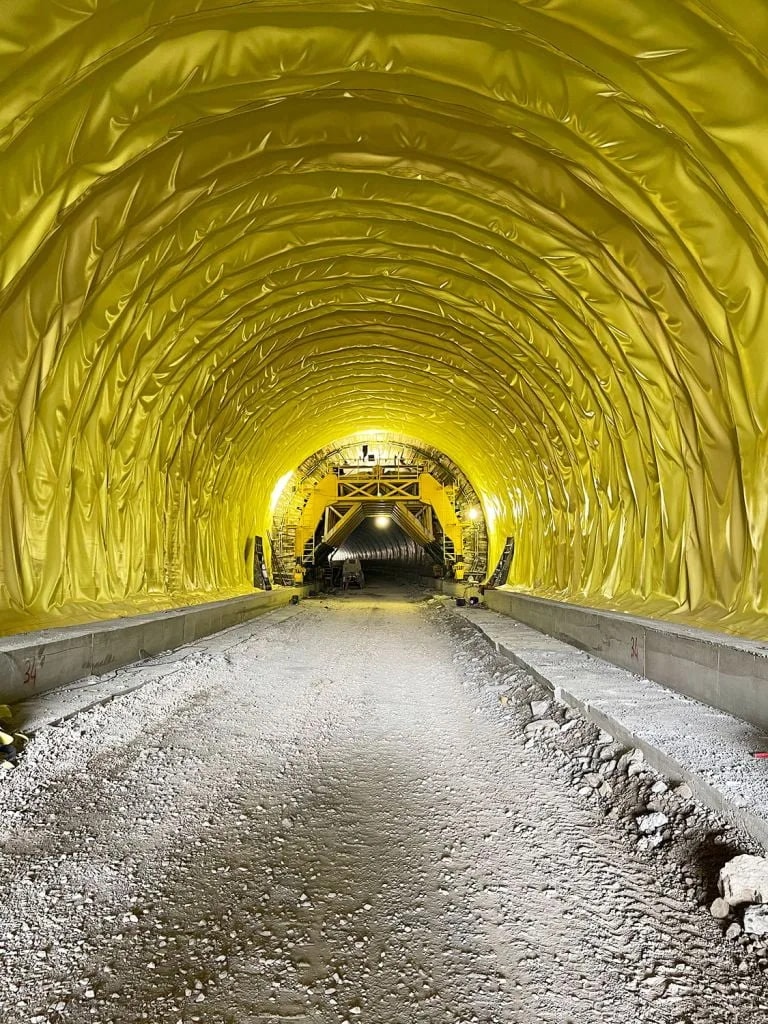
In these structures a GCL is used both on the base slab and vertically on diaphragm walls. In deep excavations exposed to artesian water pressure, the mechanical bond the bentonite forms with fresh concrete keeps the seal intact even through structural movement or shrinkage cracks — a decisive reason for choosing it, particularly in urban projects with a high water table.
Foundation Waterproofing and Tanking
In under-slab and diaphragm-wall tanking, the GCL is fixed directly to the formwork or the reinforcement and concrete is poured over it; the needle-punched non-woven fibres penetrate the cement paste and form a permanent mechanical bond. This method can be applied without a separate protection concrete or screed.
Solid and Hazardous Waste Landfills
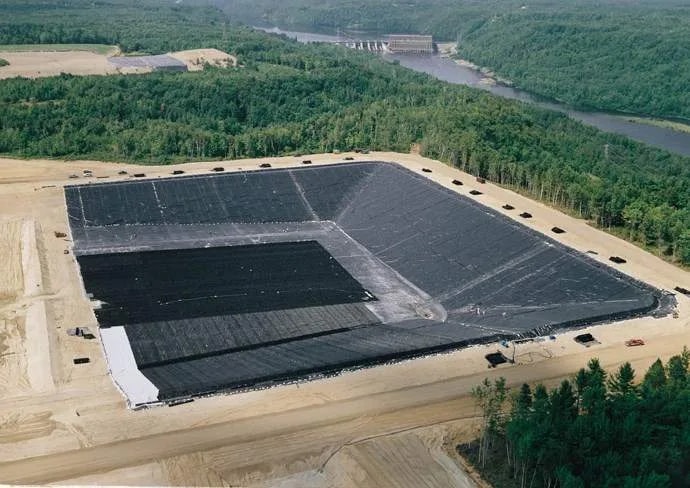
On these sites a GCL is mostly used not alone but as part of a composite barrier system together with a geomembrane. Should a manufacturing or field-induced puncture occur in the geomembrane, the GCL beneath it comes into play as a secondary sealing layer and reduces the leakage risk of the total system.
Ponds, Pools, Irrigation Canals and Water Conveyance Lines
In large-area water structures a GCL is laid quickly because it requires no field welding; it also conforms to irregular base topography more readily than a geomembrane.
Dams and Flood Control
In embankment dam bodies and at the base of dykes and fills — large structures carrying a risk of settlement and differential movement — the self-healing property of bentonite keeps the seal intact through the micro-cracks that may form over time.
Oil Fields
One technical warning matters in this application: the swelling and permeability performance of sodium bentonite can change on contact with liquids of high salinity or hydrocarbon content. Using a GCL alone as the primary barrier is not recommended without verifying chemical compatibility by ASTM D6766 (permeability with incompatible liquids); on these sites a composite system with a geomembrane is generally preferred.
Measured values.
The values below are typical/minimum limits. A lot-specific certified test report should be requested before ordering.
| Property | Test Standard | Typical Value |
|---|---|---|
| Bentonite type | — | Natural sodium bentonite (granular) |
| Bentonite content | ASTM D5993 | 4.000 – 5.000 g/m² |
| Carrier geotextile | — | Woven polypropylene |
| Cover geotextile | — | Non-woven polypropylene |
| Bonding method | — | Needle-punching |
| Swell index | ASTM D5890 / GRI-GCL3 | ≥ 24 mL/2g |
| Swell ratio (by volume) | — | ~15× (at full hydration) |
| Permeability (fully hydrated) | ASTM D5887 / GRI-GCL3 | ≤ 5×10⁻⁹ cm/sn |
| Internal shear strength | ASTM D6243 | Reported at project-specific normal stresses |
| Peel strength | ASTM D6496 | ≥ 360 N/m |
| Tensile strength | ASTM D6768 | ≥ 4,0 kN/m (MD) |
| Chemical compatibility | ASTM D6766 | Verified per project |
Peel and tensile values are GRI-GCL3 minimums; internal shear depends on needle-punching density and project stresses. Request the current MQC report before ordering.
| Parameter | Value |
|---|---|
| Roll width | 4 – 5 m (typical) |
| Roll length | 40 – 60 m (typical) |
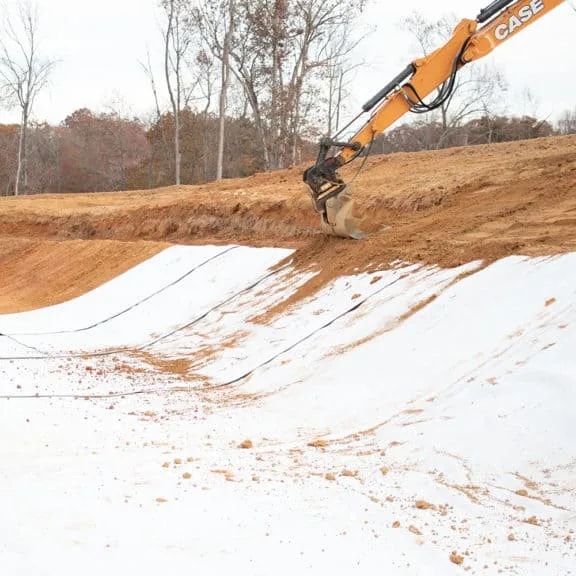
| Colour | Beige / light brown (non-woven face) |
In brief
- Sodium bentonite swells to approximately 15 times its original volume at full hydration
- A swell index verified by ASTM D5890, meeting the GRI-GCL3 minimum limit of 24 mL/2g
- Mechanical internal shear strength provided by needle-punching (ASTM D6243)
- A non-woven geotextile structure that penetrates fresh concrete to form a mechanical bond
- Self-healing at punctures, seam overlaps and penetration points
- Fast, low-error installation requiring no field welding
Test standards
- ASTM D5890
- Test Method for Swell Index of Bentonite
- ASTM D5891
- Test Method for Fluid Loss
- ASTM D5993
- Test Method for Mass per Unit Area
- ASTM D5887
- Test Method for Index Flux with Standard Liquid
- ASTM D6766
- Test Method for Permeability with Incompatible Liquids
- ASTM D6243
- Test Method for Internal/Interface Shear Strength (Direct Shear)
- ASTM D6496
- Test Method for Peel Strength of Needle-Punched GCLs
- ASTM D6768
- Test Method for Tensile Strength
- GRI-GCL3
- GCL Required Properties and Testing Frequencies
Rolls are dispatched wrapped in stretch film to prevent premature hydration of the bentonite through moisture uptake. They should be stored on wooden pallets in an enclosed, dry area protected from direct moisture. Rolls that have become wet or prematurely hydrated must not be used on site.
- Peel, tensile and permeability values are GRI-GCL3 minimum limit values; certified, lot-specific test results for our product family are available on request.
- For applications in contact with liquids of high salinity, hardness or hydrocarbon content, ASTM D6766 chemical compatibility testing is strongly recommended.
- In landfill and oil-field applications, using the GCL within a composite system together with a geomembrane is recommended for secondary barrier redundancy.
- Careful handling is required during site installation to prevent mechanical damage (tearing, puncture) before swelling.
“A GCL is an active barrier that self-heals puncture points — certified, lot-specific test results are shared on request.”
A choice grounded in data.
The performance of a GCL rests on verifying bentonite quality by the ASTM D5890 swell index test and permeability under ASTM D5887 / GRI-GCL3. Because a GCL's real performance on site depends on the homogeneity of bentonite distribution and on needle-punching density, requesting a lot-specific test report is the only way to predict field performance in advance.
Frequently asked
What is the difference between a GCL and an HDPE geomembrane?
A geomembrane acts as a physical barrier — it is itself an impermeable plastic sheet — and if punctured it stays passive. A GCL, by contrast, provides an active seal through the swelling of the sodium bentonite inside it on contact with water; it can close small punctures and penetration points by itself.
How much does bentonite swell?
At full hydration, sodium bentonite can swell to roughly 15 times its original volume. This ratio varies with the source of the bentonite and the ionic content of the water; in saline or hard water the swelling ratio falls.
Is a GCL used alone, or together with a geomembrane?
In high-risk applications such as landfills and oil fields it is generally used together with a geomembrane, as a composite system. In foundation tanking, tunnels and water structures it can also be applied alone as the primary barrier.
What is a GCL's chemical resistance — can it be used with any liquid?
The swelling and permeability performance of sodium bentonite can change on contact with liquids of high salinity, hardness or hydrocarbon content. In aggressive chemical environments, compatibility testing to ASTM D6766 is recommended before use.
How is a GCL installed?
After the rolls are laid, additional bentonite powder is spread at the overlap zones to support the seal along the overlap line. In vertical applications (diaphragm walls, foundation tanking) the material is fixed mechanically to the formwork or the reinforcement; no heat welding is required.
What is the role of the woven and non-woven geotextiles inside a GCL?
The woven geotextile acts as the carrier layer, taking the weight of the bentonite and the tensile load; the non-woven geotextile wraps the bentonite granules like a protective cover, and the fibres created during needle-punching provide the mechanical interlock between the two layers.
What is the service life of a GCL?
In buried conditions, as long as it suffers no mechanical damage, the swelling capacity of the bentonite is preserved over the long term. However, aggressive chemical exposure or repeated wetting–drying cycles can degrade the bentonite's performance over time through ion exchange. For this reason it is recommended that it be kept continuously moist or buried, beneath a cover or fill.
The water pressure, ground movement and chemical exposure conditions of your project are unique — and whether a GCL should be used alone or as part of a composite system follows from them. Request a project-specific technical quote and a bentonite quality report from the Geoals technical team.